
If your preparation for reading understanding complex sentence structures has felt scattered or unfocused, this guide will give you the structure you need. Every tip here is backed by what actually works in practice.
Why Understanding Complex Sentence Structures Matters
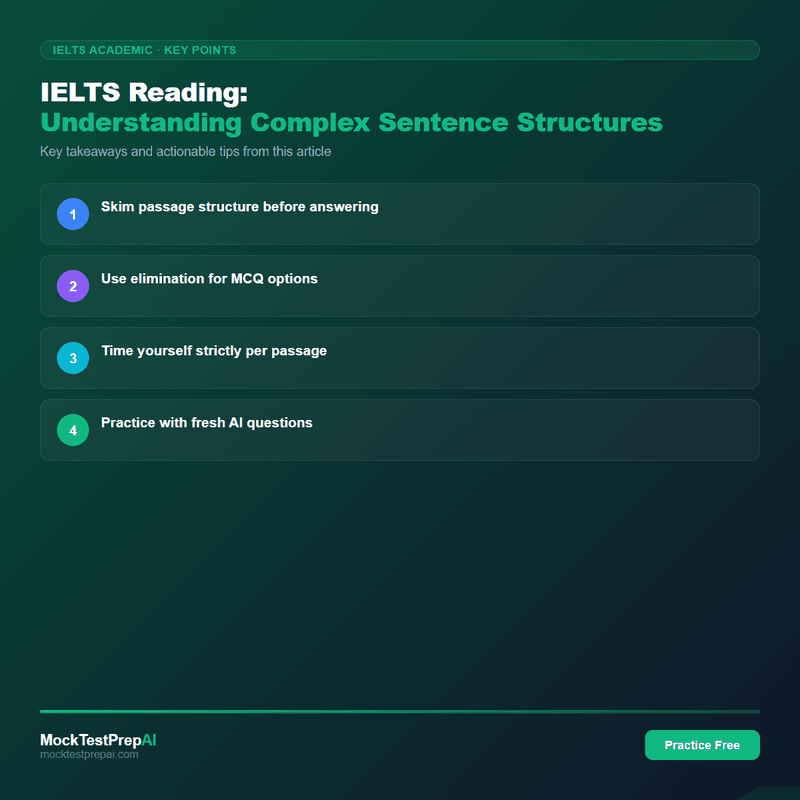
The IELTS reading section gives you 60 minutes for 40 questions across three passages. Time management is critical here. A common strategy is to spend 15 minutes on Passage 1, 20 minutes on Passage 2, and 25 minutes on Passage 3, since the difficulty increases with each passage. However, you should adjust this based on your personal strengths.
Build your academic vocabulary systematically. Many reading questions test whether you understand specific academic words. Keep a vocabulary notebook with words from practice passages, and review them regularly using spaced repetition.
So how do you actually put this into practice? The following approach has consistently worked for students at every level.
Key Strategies for IELTS Reading
IELTS uses a band scoring system from 0 to 9, with half-band increments. Each section is scored independently, and the overall band score is an average of all four sections, rounded to the nearest half band. Understanding this system is crucial for planning your preparation strategy, because sometimes improving one section by half a band can change your overall score.
Reading speed and comprehension are the twin engines of your reading score. If you read slowly, you will run out of time. If you read fast but carelessly, you will make errors. Practice finding the balance where you read quickly enough to finish all questions while still understanding the key points.
Practical Tips to Improve
Here are specific actions you can take starting today:
- Tip: Study the band descriptors until you understand exactly what each band level looks like
- Tip: For matching headings, eliminate paragraphs you are certain about first
- Tip: Practice using a range of tenses naturally in your speaking responses
- Tip: In writing, aim for 270+ words in Task 2 and 170+ words in Task 1
Let's look at some specific examples that illustrate these principles in action.
Practice this skill with AI-powered mock tests
MockTestPrepAI generates fresh questions every time with instant AI scoring and phoneme-level pronunciation feedback. Start Free →
Building a Consistent Practice Routine
Your improvement timeline depends on your starting point and how consistently you practice. Most students see noticeable progress within two to three weeks of applying these strategies. Stay patient, stay focused, and the results will follow.
What to Focus on This Week
Choose one or two strategies from the list above and practice them consistently for the next seven days. Track your progress by noting how comfortable you feel with each technique and whether you see improvement in your practice scores. After a week, evaluate what worked and adjust your plan for the following week. This iterative approach ensures that your preparation stays targeted and effective.
For the best results, combine self-study with regular AI-scored practice sessions. The immediate feedback helps you catch errors early and correct them before they become habits. Explore your options at MockTestPrepAI pricing to find a plan that fits your preparation timeline.
Related Articles
- IELTS Speaking: Overcoming Nervousness in the Interview
- PTE Reading: Building Comprehension Through Regular Reading
- IELTS Writing: Practice Schedule for 4 Weeks
Ready to Ace Your Exam?
Join thousands of students who improved their scores with MockTestPrepAI's AI-powered practice.
Start Free — No Credit Card Needed