
If you have been struggling with reading academic vocabulary building, you are not alone. Thousands of test takers face this exact challenge every month, and the good news is that the solution is more straightforward than you might expect.
Why Academic Vocabulary Building Matters
TOEFL MyBest scores combine your highest section scores from all valid test attempts within the past two years. Many universities now accept MyBest scores, which means that even if you do not hit your target in every section on a single attempt, you may still meet the requirement through multiple sittings. Check whether your target institution accepts MyBest scores before planning your strategy.
Reading speed and comprehension are the twin engines of your reading score. If you read slowly, you will run out of time. If you read fast but carelessly, you will make errors. Practice finding the balance where you read quickly enough to finish all questions while still understanding the key points.
The next step is translating this knowledge into a practical study routine that fits your schedule.
Key Strategies for TOEFL Reading
TOEFL speaking tasks require you to respond into a microphone, and your responses are recorded for scoring. Unlike a conversation, there is no back-and-forth. You hear the prompt, get a brief preparation time, and then speak for a set duration. Practicing under these exact conditions is essential because the format itself can feel unnatural if you are not prepared for it.
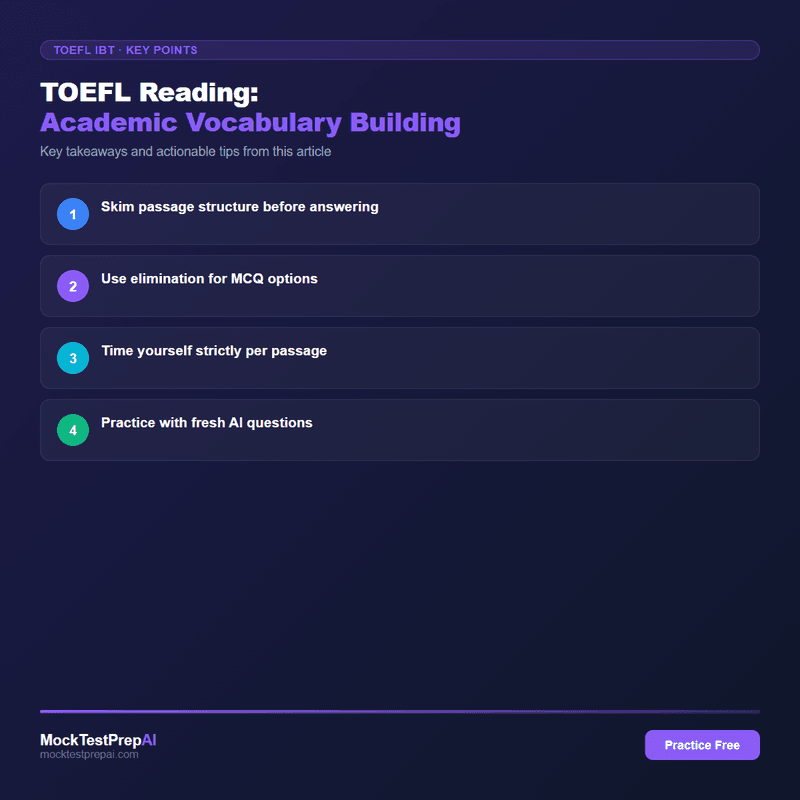
Do not read every word of every passage with equal attention. Skim to get the general structure, then scan for specific information when answering questions. This strategic reading approach saves significant time without sacrificing accuracy.
Practical Tips to Improve
Here are specific actions you can take starting today:
- Tip: Practice the independent speaking task by recording 45-second responses to opinion prompts
- Tip: For integrated writing, create a T-chart comparing reading points with lecture counterpoints
- Tip: Read academic journals to build familiarity with TOEFL-style passage topics
Once you have these basics down, the following strategies will help you refine your approach further.
Practice this skill with AI-powered mock tests
MockTestPrepAI generates fresh questions every time with instant AI scoring and phoneme-level pronunciation feedback. Start Free →
Building a Consistent Practice Routine
Success on this part of the exam is not about talent or luck. It is about preparation, technique, and consistency. The strategies in this guide give you a clear path forward. What matters now is putting them into action.
What to Focus on This Week
Choose one or two strategies from the list above and practice them consistently for the next seven days. Track your progress by noting how comfortable you feel with each technique and whether you see improvement in your practice scores. After a week, evaluate what worked and adjust your plan for the following week. This iterative approach ensures that your preparation stays targeted and effective.
For the best results, combine self-study with regular AI-scored practice sessions. The immediate feedback helps you catch errors early and correct them before they become habits. Explore your options at MockTestPrepAI pricing to find a plan that fits your preparation timeline.
Related Articles
- TOEFL Writing: Word Count and Response Length Guide
- TOEFL Integrated Writing: Note-Taking from Reading
- TOEFL Reading: From Score 20 to 28 Plan
Ready to Ace Your Exam?
Join thousands of students who improved their scores with MockTestPrepAI's AI-powered practice.
Start Free — No Credit Card Needed