
Let's be honest about listening science lecture strategies. Most advice you find online is either too vague to be useful or so complicated that it creates more confusion than clarity. This guide takes a different approach.
Why Science Lecture Strategies Matters
The TOEFL reading section features academic passages from university-level textbooks covering topics in science, social science, and arts. You do not need specialized knowledge to answer the questions correctly since all answers are found within the passage. However, familiarity with academic writing conventions and vocabulary makes the process much faster.
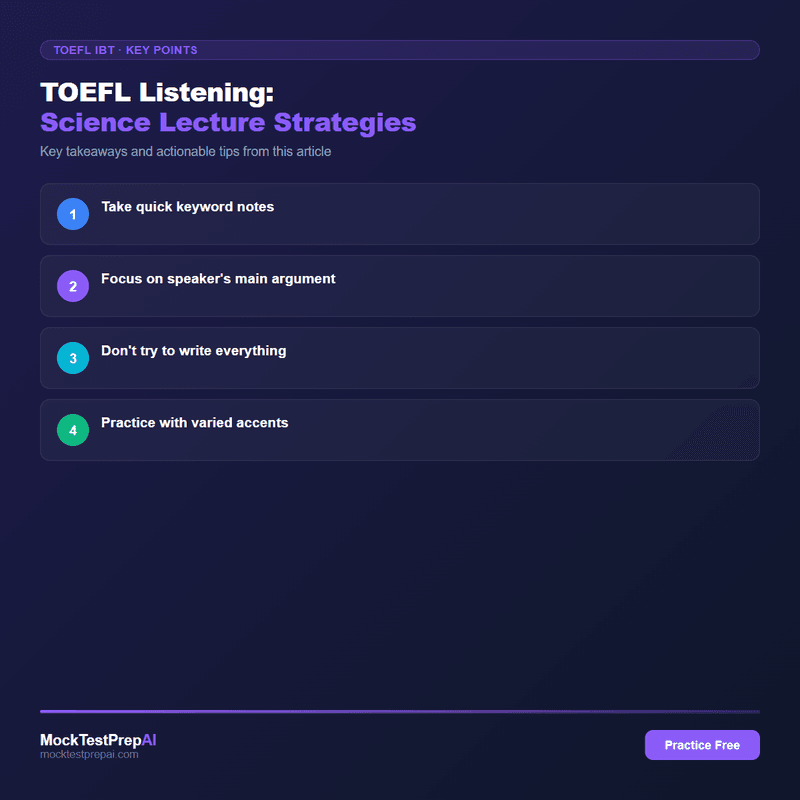
Expose yourself to multiple English accents. Exam listening sections may feature British, American, Australian, Canadian, or other accents. If you only practice with one accent, you may struggle to understand others on test day.
Let's look at some specific examples that illustrate these principles in action.
Key Strategies for TOEFL Listening
TOEFL iBT scores each section from 0 to 30, with a total score range of 0 to 120. The reading and listening sections are scored by computer, while speaking and writing receive a combination of AI and human scoring. Understanding this scoring system helps you set realistic targets for each section based on your overall score goal.
Listening practice should include both focused and passive components. During focused practice, take notes and answer questions actively. During passive practice, simply listen to English audio throughout your day to build general comprehension.
Practical Tips to Improve
Here are specific actions you can take starting today:
- Tip: For integrated speaking tasks, focus on accurately reporting the source material, not adding opinions
- Tip: Practice typing at speed while maintaining accuracy for the writing section
- Tip: Listen to university course lectures on YouTube for realistic listening practice
With that foundation in place, it is time to look at the practical strategies you can start using immediately.
Practice this skill with AI-powered mock tests
MockTestPrepAI generates fresh questions every time with instant AI scoring and phoneme-level pronunciation feedback. Start Free →
Building a Consistent Practice Routine
Your improvement timeline depends on your starting point and how consistently you practice. Most students see noticeable progress within two to three weeks of applying these strategies. Stay patient, stay focused, and the results will follow.
What to Focus on This Week
Choose one or two strategies from the list above and practice them consistently for the next seven days. Track your progress by noting how comfortable you feel with each technique and whether you see improvement in your practice scores. After a week, evaluate what worked and adjust your plan for the following week. This iterative approach ensures that your preparation stays targeted and effective.
For the best results, combine self-study with regular AI-scored practice sessions. The immediate feedback helps you catch errors early and correct them before they become habits. Explore your options at MockTestPrepAI pricing to find a plan that fits your preparation timeline.
Related Articles
- TOEFL Speaking: Recording and Self-Assessment Guide
- TOEFL Reading: Insert Text Questions Strategy
- PTE Listening: The Complete Scoring Breakdown
Ready to Ace Your Exam?
Join thousands of students who improved their scores with MockTestPrepAI's AI-powered practice.
Start Free — No Credit Card Needed