
The first time I encountered questions about for graduate school applications, I realized that most students approach it backwards. They focus on quantity of practice when they should focus on quality and technique.
Understanding TOEFL for Graduate School Applications
TOEFL speaking tasks require you to respond into a microphone, and your responses are recorded for scoring. Unlike a conversation, there is no back-and-forth. You hear the prompt, get a brief preparation time, and then speak for a set duration. Practicing under these exact conditions is essential because the format itself can feel unnatural if you are not prepared for it.
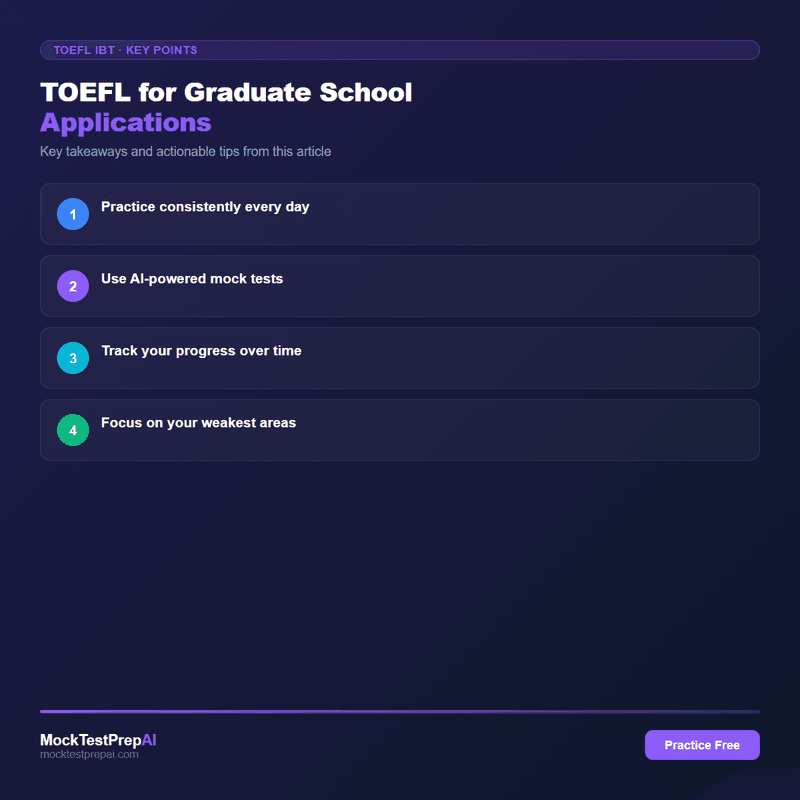
Your overall preparation strategy should balance time across all sections rather than spending all your time on your weakest area. Diminishing returns set in quickly when you over-study one skill. A balanced approach typically produces the best overall score.
Now that we have covered the basics, let's dig into the specific techniques that make the biggest difference.
Key Strategies for TOEFL for Graduate School Applications
The TOEFL integrated tasks are unique among English proficiency tests. They require you to combine information from reading passages and listening lectures, then express your synthesis in speaking or writing. This tests your ability to function in an actual academic environment, where you constantly integrate information from multiple sources.
Mock tests serve two purposes: they measure your current level and they build test-taking stamina. Take at least one full-length mock test per week in the final month of your preparation, simulating real test conditions as closely as possible.
Practical Tips to Improve
Here are specific actions you can take starting today:
- Tip: Learn signal words that indicate contrast, addition, and conclusion in lectures
- Tip: For the Academic Discussion task, write a clear topic sentence and provide a specific example
- Tip: Practice identifying the main idea of each paragraph as you read
So how do you actually put this into practice? The following approach has consistently worked for students at every level.
Practice this skill with AI-powered mock tests
MockTestPrepAI generates fresh questions every time with instant AI scoring and phoneme-level pronunciation feedback. Start Free →
Building a Consistent Practice Routine
The difference between test takers who achieve their target score and those who fall short often comes down to whether they practiced strategically or just went through the motions. Use these techniques with intention, and you will put yourself in the best position to succeed.
What to Focus on This Week
Choose one or two strategies from the list above and practice them consistently for the next seven days. Track your progress by noting how comfortable you feel with each technique and whether you see improvement in your practice scores. After a week, evaluate what worked and adjust your plan for the following week. This iterative approach ensures that your preparation stays targeted and effective.
For the best results, combine self-study with regular AI-scored practice sessions. The immediate feedback helps you catch errors early and correct them before they become habits. Explore your options at MockTestPrepAI pricing to find a plan that fits your preparation timeline.
Related Articles
- TOEFL Writing: Spelling and Punctuation Tips
- PTE Test Format Changes in 2026: What Is New
- TOEFL Reading: Social Science Passage Tips
Ready to Ace Your Exam?
Join thousands of students who improved their scores with MockTestPrepAI's AI-powered practice.
Start Free — No Credit Card Needed