
When it comes to the role of immersion in language learning, many test takers waste weeks practicing the wrong way. The result? Frustration, stagnation, and scores that refuse to budge. There is a better path forward.
Understanding The Role of Immersion in Language Learning
Vocabulary building for academic English exams should prioritize the Academic Word List, which contains the most frequently used words in academic texts. Rather than memorizing dictionary definitions, learn each word through multiple example sentences and try to use new words in your own speaking and writing practice within 24 hours of learning them.
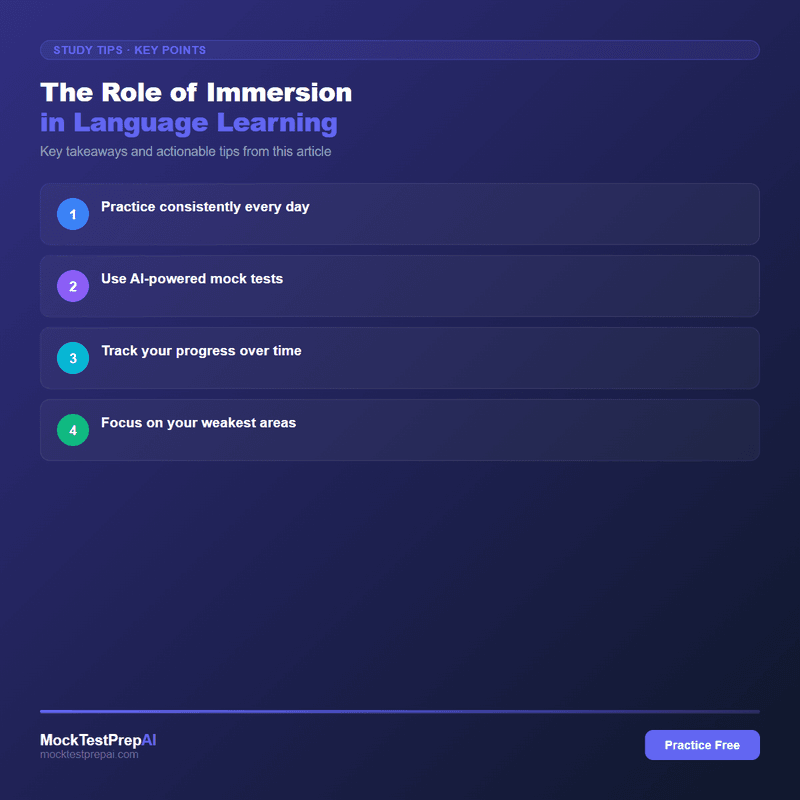
The most effective study sessions have a clear goal. Before each session, decide exactly what you want to accomplish. 'Study for one hour' is less effective than 'practice 10 Reorder Paragraph questions and review all errors.'
Once you have these basics down, the following strategies will help you refine your approach further.
Key Strategies for The Role of Immersion in Language Learning
Research consistently shows that extensive reading is one of the most effective ways to improve English comprehension and vocabulary simultaneously. Set a goal of reading at least one academic article per day, noting unfamiliar words and their context. Over time, this habit builds both your vocabulary and your reading speed without feeling like traditional study.
Track your scores over time in a spreadsheet or journal. Seeing concrete progress is motivating, and identifying when your improvement plateaus tells you when to change your approach.
Practical Tips to Improve
Here are specific actions you can take starting today:
- Tip: Learn 5 new academic vocabulary words daily using spaced repetition flashcards
- Tip: Practice pronunciation by reading aloud for 10 minutes every morning
- Tip: Write one paragraph daily on a topic you find interesting to build writing fluency
- Tip: Listen to English podcasts during commute time to build passive listening skills
Understanding the theory is important, but what really matters is how you apply it. Here are the actionable steps.
Practice this skill with AI-powered mock tests
MockTestPrepAI generates fresh questions every time with instant AI scoring and phoneme-level pronunciation feedback. Start Free →
Building a Consistent Practice Routine
The difference between test takers who achieve their target score and those who fall short often comes down to whether they practiced strategically or just went through the motions. Use these techniques with intention, and you will put yourself in the best position to succeed.
What to Focus on This Week
Choose one or two strategies from the list above and practice them consistently for the next seven days. Track your progress by noting how comfortable you feel with each technique and whether you see improvement in your practice scores. After a week, evaluate what worked and adjust your plan for the following week. This iterative approach ensures that your preparation stays targeted and effective.
For the best results, combine self-study with regular AI-scored practice sessions. The immediate feedback helps you catch errors early and correct them before they become habits. Explore your options at MockTestPrepAI pricing to find a plan that fits your preparation timeline.
Related Articles
- Pronunciation Practice: Shadowing Technique
- Topic-Specific Vocabulary: Society and Culture
- Error Journals: Learning from Your Mistakes
Ready to Ace Your Exam?
Join thousands of students who improved their scores with MockTestPrepAI's AI-powered practice.
Start Free — No Credit Card Needed