
If your preparation for parallel structure in academic writing has felt scattered or unfocused, this guide will give you the structure you need. Every tip here is backed by what actually works in practice.
Understanding Parallel Structure in Academic Writing
Pronunciation improvement is not about eliminating your accent. It is about being clear and intelligible. Native speakers have accents too. The goal is to produce the sounds of English clearly enough that any listener can understand you without strain. Focus on the specific sounds that differ most between your first language and English.
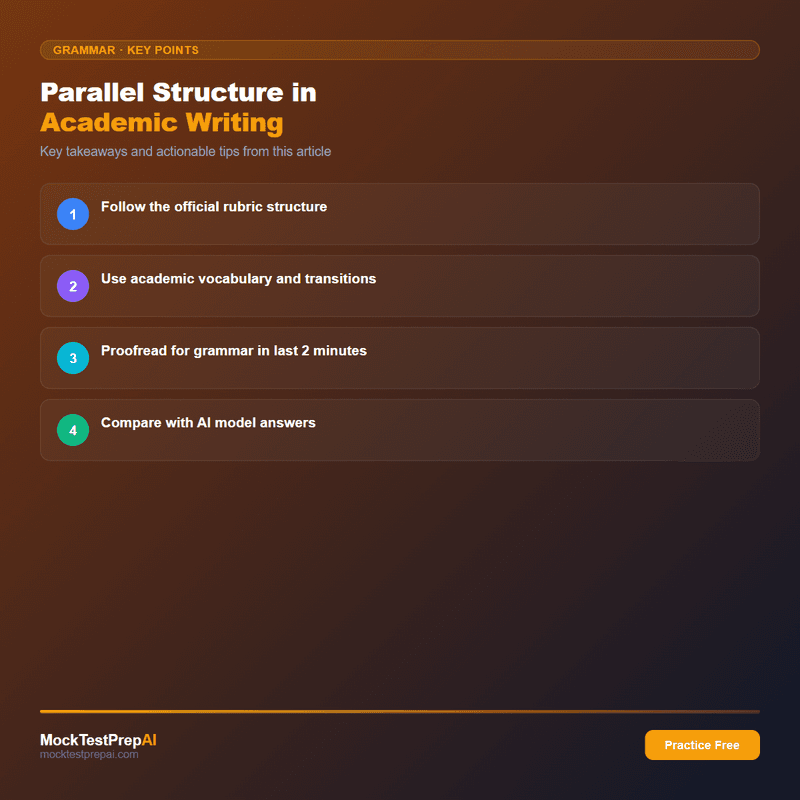
Practice grammar in the context of writing and speaking, not just through fill-in-the-blank exercises. Being able to circle the right answer in a grammar exercise does not guarantee you will use the same structure correctly in your own writing.
So how do you actually put this into practice? The following approach has consistently worked for students at every level.
Key Strategies for Parallel Structure in Academic Writing
Vocabulary building for academic English exams should prioritize the Academic Word List, which contains the most frequently used words in academic texts. Rather than memorizing dictionary definitions, learn each word through multiple example sentences and try to use new words in your own speaking and writing practice within 24 hours of learning them.
Grammar rules are tools, not obstacles. Each rule exists to help you communicate more clearly. When you learn a grammar point, focus on understanding why it works that way, not just memorizing the rule.
Practical Tips to Improve
Here are specific actions you can take starting today:
- Tip: Use the chunking method to break long texts into manageable sections
- Tip: Practice connected speech by linking words together when reading aloud
- Tip: Study word families to expand your vocabulary efficiently
- Tip: Set specific, measurable goals for each week of study
Let's look at some specific examples that illustrate these principles in action.
Practice this skill with AI-powered mock tests
MockTestPrepAI generates fresh questions every time with instant AI scoring and phoneme-level pronunciation feedback. Start Free →
Building a Consistent Practice Routine
Success on this part of the exam is not about talent or luck. It is about preparation, technique, and consistency. The strategies in this guide give you a clear path forward. What matters now is putting them into action.
What to Focus on This Week
Choose one or two strategies from the list above and practice them consistently for the next seven days. Track your progress by noting how comfortable you feel with each technique and whether you see improvement in your practice scores. After a week, evaluate what worked and adjust your plan for the following week. This iterative approach ensures that your preparation stays targeted and effective.
For the best results, combine self-study with regular AI-scored practice sessions. The immediate feedback helps you catch errors early and correct them before they become habits. Explore your options at MockTestPrepAI pricing to find a plan that fits your preparation timeline.
Related Articles
- Run-On Sentences: How to Fix Them
- The Pomodoro Technique for Exam Study
- Conditional Sentences: Zero to Third Conditional
Ready to Ace Your Exam?
Join thousands of students who improved their scores with MockTestPrepAI's AI-powered practice.
Start Free — No Credit Card Needed